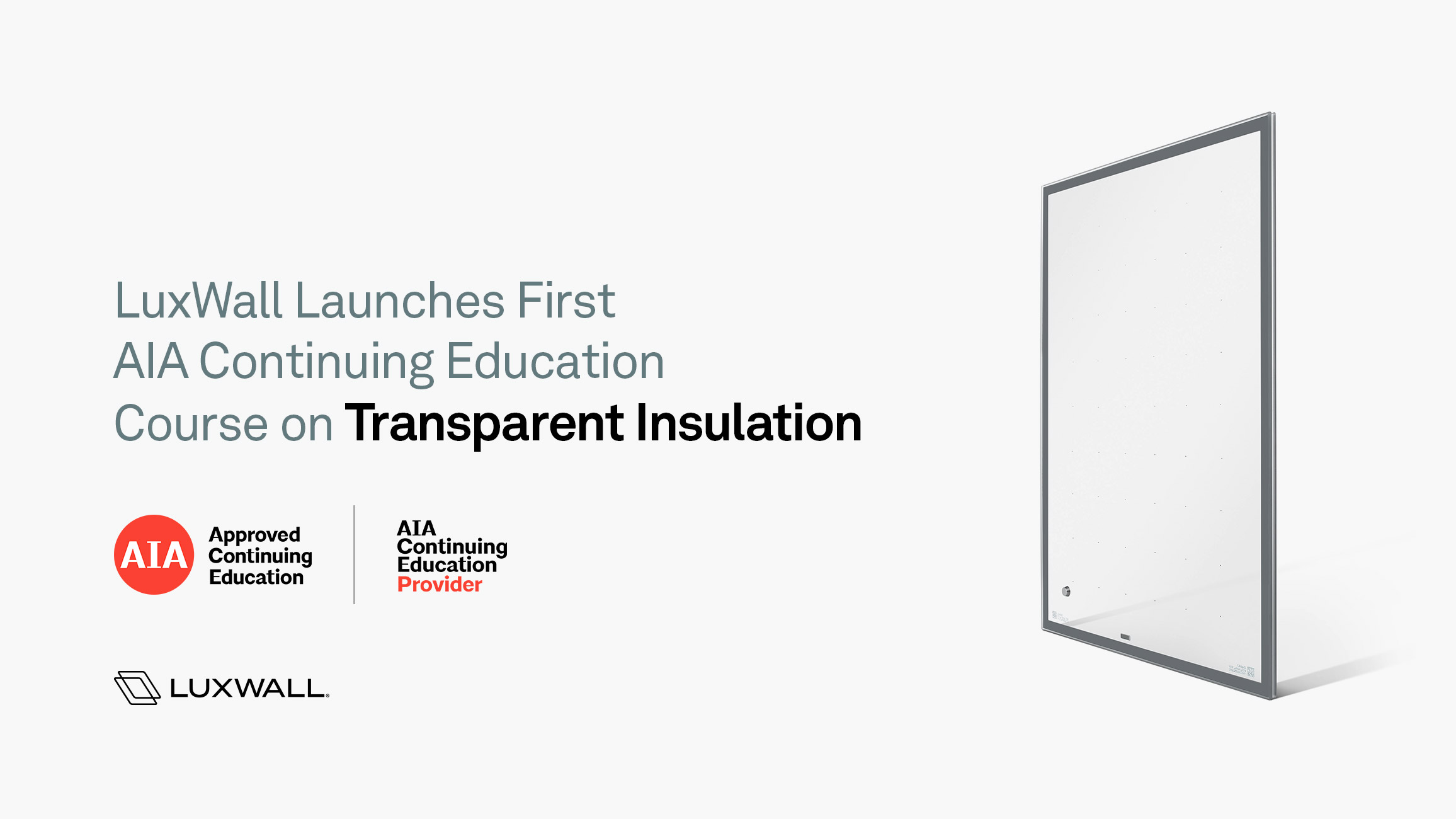
Ypsilanti, Michigan — September 23, 2026 — LuxWall, the energy savings company, today announced the launch of the first American Institute of Architects (AIA) continuing education course dedicated to Transparent Insulation. The course provides architecture professionals with a technical introduction to Transparent Insulation, including heat transfer fundamentals, energy saving performance, occupant health, safety, and welfare considerations, and performance comparisons with traditional glazing solutions.
As architects face increasingly stringent energy codes and building performance requirements including pressure to reduce the window to wall ratio to meet these standards, the course examines how advances in glazing can help address one of the most significant sources of energy loss in buildings.
“Architects are being asked to design buildings that deliver dramatically better energy performance without compromising daylight, views, aesthetics, occupant comfort, or design intent,” said Scott Thomsen, CEO and Founder of LuxWall. “Transparent Insulation gives the industry a new breakthrough to address that challenge. By introducing the first AIA continuing education course focused specifically on this new category, our goal is to give architects the technical foundation they need to understand how Transparent Insulation works, where it can be applied, and the role it can play in the next generation of high-performance buildings.”
The course provides a comprehensive introduction to the fundamental science behind Transparent Insulation, including how vacuum reduces and/or eliminates conductive, convective, and radiative heat transfer to achieve significantly higher R-values. Participants are introduced to the key components of Transparent Insulation, including low-E coated and clear tempered glass, structural micro-pillars, a getter, a hermetic edge seal, and an evacuation port.
A key component of the course is the comparison of Transparent Insulation with standard double- and triple-pane insulating glass systems across thermal, optical, acoustic, and embodied-carbon performance. At comparable visible light transmittance and solar heat gain coefficient, Transparent Insulation delivers approximately three to six times the center-of-glass R-value of conventional double- and triple-pane IGUs in a slimmer profile.
At the conclusion of the course, participants will be able to explain heat-transfer fundamentals, describe how vacuum improves thermal performance, identify health, safety, and welfare-related performance impacts, and compare Transparent Insulation with conventional insulating glass systems to inform specification decisions.
The Transparent Insulation – LW-001 course is approved for 1 Learning Unit (LU) Elective through AIA Continuing Education.
The course objectives include:
- How conduction, convection, and radiation drive heat loss and heat gain in fenestration systems.
- How vacuum insulation technology suppresses conduction, convection, and radiation to achieve R-18 Center of Glass performance.
- How transparent insulation affects frame temperature, condensation resistance, and acoustic performance relevant to occupant health, safety, and welfare.
- Comparison of the thermal, optical, acoustic, and embodied-carbon performance of transparent insulation to standard double-pane and triple-pane insulating glass units to inform specification decisions.
Architects and design professionals can request an in-person session here.
About LuxWall
Headquartered in Ypsilanti, MI, USA, LuxWall is focused on product development, scaling, and commercialization of innovative energy-efficient products and solutions for the built environment. LuxWall’s Transparent Insulation provides a step change in energy performance by eliminating or significantly reducing convective, conductive, and radiative heat gain and heat loss in buildings. LuxWall manufactures its Transparent Insulation product line at its Litchfield, Michigan manufacturing plant, and is constructing its second manufacturing plant in Detroit, Michigan.
Learn more at www.luxwall.com